Sunday, April 14, 2013

Half-Human, Half Ape Ancestor Walked Pigeon-Toed

Two million years ago in South Africa, part-human and part-ape-like individuals existed — and now we know what they looked like and how they behaved: They had a primitive, pigeon-toed gait, human-like front teeth, ate mostly veggies and spent a lot of time swinging in the trees.

The species, Australopithecus sediba, is a striking example of human evolution, conclude six papers published in the journal Science. Taken together, the papers describe how Au. sediba looked, walked, chewed and moved.

“Sediba shows a strange mix of primitive australopithecine traits and derived Homo traits — face and anterior dentition like Homo, shape of the cranium like Homo, other parts of the face and size of the cranium like an australopithecine, arms like an australopithecine, pelvis and lower limbs like Homo and feet and ankles like an australopithecine,” project leader Lee Berger told Discovery News.

PHOTOS: Faces of Our Ancestors

“It does look like a good ‘transitional’ fossil, doesn’t it?” added Berger, who is a researcher in the Wits Evolutionary Studies Institute at the University of the Witwatersrand. He named the species, which was found at a site called Malapa, near Johannesburg.

The tooth study found that Au. sediba was closely related to Au. africanus, which lived until about 2.1 million years ago. These species, in turn, shared numerous dental similarities with Homo erectus, an early human species.

“All of the research so far shows that sediba had a mosaic of primitive traits and newer traits that suggest it was a bridge between earlier australopiths and the first humans,” said Debbie Guatelli-Steinberg, co-author of one of the studies and a professor of anthropology at Ohio State University.

NEWS: ‘Ardi,’ Oldest Human Ancestor, Unveiled

Prior research determined what Au. sediba ate.

Peter Schmid of the University of Zurich, who also analyzed this species’ remains, shared that the early probable ancestor was not a carnivore.

“Microscopic elements of plants were found in the tartar of the teeth of Au. sediba,” Schmid told Discovery News. “It was largely a vegetarian and shows a rather human-like chewing apparatus.”

In terms of how it walked, Schmid and the other researchers explained that Au. sediba had a small heel resembling that of a chimp. It walked rather awkwardly — with an inward rotation of the knee and hip, with its feet slightly twisted. The scientists conclude that this pigeon-toed way of walking on two limbs might have been an evolutionary compromise between walking upright and tree climbing.

Such a detailed understanding of these movements is possible because remains for a female Au. sediba preserve her heel, ankle, knee, hip and lower back. In contrast, the famous “Lucy” skeleton, representative of the species Au. afarensis, only preserves a hip and ankle.

Yet another new study analyzed Au. sediba’s upper limbs. They were “primitive,” meaning more like those of an ape, suggesting that these individuals still spent some time swinging and climbing in trees.

This again makes Au. sediba a good candidate as a transitional species, because it appears to have spent most of its time on the ground, but it hadn’t entirely left the trees yet.

“The terrestrial adaptation was much more evolved, but there are indications that it had still a large part of climbing in its locomotor spectrum,” Schmid explained.

All in all, the papers make a strong case that early human evolution took place in South Africa following an expected sequential manner, from more ape-like to more human-associated characteristics.

The case isn’t closed yet, however, as still other researchers believe that additional australopithecines, such as Lucy, gave rise to our ancestors. Lucy’s species has only been found in northern Africa so far.

Africa was clearly a hotbed of early human evolution, but further research is needed to pinpoint exactly where our lineage began.

Gottfried: Jonathan Winters was mad brilliant

Jonathan Winters, who died Friday at 87, was a beloved comic whirlwind for generations, one whose influence on movie comics from Robin Williams to Jim Carrey to Sacha Baron Cohen is very apparent.

Comedian Jonathan Winters, whose breakneck improvisations inspired Robin Williams, Jim Carrey and many others, has died at age 87. Longtime family friend Joe Petro III says the Ohio native died Thursday evening at his

Hollywood legend Jonathan Winters was working like a champ right up until his death — voicing Papa Smurf for the upcoming "Smurfs 2" movie just last week…

Highlights from the career of the comic Jonathan Winters, who died on Thursday.

(CNN) — Jonathan Winters was not always in his right mind. I don't mean that only in the showbiz sense, but in the mental health sense. Jonathan, who died Thursday, was a nut as a comic, but also manic depressive and was institutionalized at least

FDA advisory panel to reconsider Avandia safety


Fri Apr 12, 2013 5:19pm EDT

(Reuters) – A federal health advisory panel in June will reconsider safety data on GlaxoSmithKline Plc’s Avandia diabetes drug, although the British drugmaker on Friday said it has not sought permission to make the nearly discontinued drug widely available again in the United States.

The U.S. Food and Drug Administration in September 2010 placed severe restrictions on use of the pill, due to heart attacks and deaths linked to the product, saying it should be available only to patients who cannot control their diabetes with any other drug. Glaxo estimates that only about 3,300 people in the United States still take the former blockbuster product.

Glaxo spokeswoman Mary Anne Rhyne said an item in the upcoming edition of the Federal Register said the FDA advisory panel will meet on June 5-6 to discuss the drug. She speculated the advisory panel will ask for an update from Glaxo on safety information it sought from the drugmaker in 2010.

The panel at the time had asked Glaxo to commission a re-examination of a large study of Avandia, called RECORD, to better assess the drug’s safety. It also asked Glaxo to devise a means of better controlling availability and use of the drug, called a Risk Evaluation and Mitigation Strategy plan.

“We haven’t asked for any changes in the drug label or in distribution for Avandia,” Rhyne said. Moreover, she said Glaxo had not requested the planned June meeting of the FDA’s Endocrinologic and Metabolic advisory panel, which will be held jointly with the FDA’s Drug Safety and Risk Management Advisory committee.

Rhyne said a group of medical experts from Duke University has re-examined the RECORD study and recently submitted its findings to the FDA. She said it found there was no significant difference in cardiovascular safety between Avandia and two other types of widely used oral drugs – metformin and sulfonylureas.

(Additional reporting by Michele Gershberg in New York; editing by Gary Hill and Matthew Lewis)

Drake trashes Chris Brown, brings up Rihanna

Drake says at one point Rihanna “fell into my lap.”

It appears that Drake and Chris Brown have not mended fences.

Last June, the two singers got into a heated altercation at a SoHo club, and on Friday, Drake, 26, slammed his RB rival, 23, on East Village Radio’s Keep It Thoro show.

“Don’t ask me (expletive) about that man when I come up there. Leave that man alone. Stop preying on his insecurities,” said Drake. “His insecurities are the fact that I make better music than him. I’m more poppin’ than him.”

He also brought up Brown’s on-again, off-again girlfriend Rihanna, who Drake also briefly dated. “At one point in life, the woman that he loves fell into my lap,” said Drake. “I did what a real (expletive) would do and treated her with respect. She’s not up there talking down on me.”

Ouch.

To take it even further, Drake took the opportunity to trash Brown’s musical skills. “I don’t want to hear that man rap,” Drake said. “Nobody wants to hear me rap against him. I really do this (expletive). Let him put out that, whatever, Project X or whatever he’s working on and I’m going to put out that real (expletive) for the people.”

Following the interview, Brown took to Twitter to send out a short tweet that simply read, “Lol.”

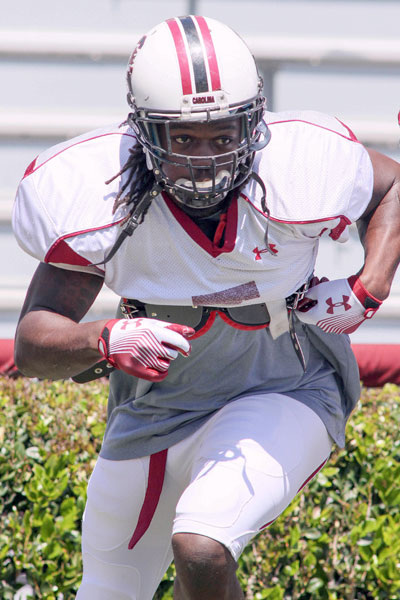
DE Jadeveon Clowney catches TD

COLUMBIA, S.C. — The most watched player at South Carolina got just one play at Saturday’s spring game.

And Jadeveon Clowney scored a touchdown.

[+] EnlargeJadeveon Clowney

Gamecocks coach Steve Spurrier had the All-American defensive end run the coach’s annual pass-to-someone-coming-off-the-sideline play. Clowney, wearing sneakers, shorts and no pads, caught the pass from freshman Connor Mitch, but awkwardly slipped as he turned for the end zone. However, the referee “missed” him hitting the ground, and Clowney threw the ball in the stands after the 54-yard touchdown.

Spurrier has always taken a breezy attitude to spring practice and his spring game. There are no real rosters — tight end Jerell Adams briefly led both the Black and the Garnett teams in receiving in the first half. Spurrier boosts scoring by having bonus kicks with just a snapper and holder after each quarter and the defenses can’t blitz and are limited to basic coverages.

“Spring practice is important for the younger guys. I guess one reason I don’t get all fired up for spring practice is I only went through one of them in my three years of them at Florida. I got hurt the other two — nothing serious,” Spurrier said of his days at quarterback with the Gators in the mid-1960s.

The Gamecocks are coming off back-to-back 11-win seasons and Spurrier thinks they have the talent to contend for the Southeastern Conference title again as long as hard work follows.

“I think we do have the chance to have a good team,” Spurrier said. “But it could go anywhere to winning season to big winning season to losing season.”

Plenty of eyes will be on Clowney, who is one of the most hyped defensive player in the country. Clowney sitting out Saturday wasn’t a surprise. Defensive coordinator Lorenzo Ward said before drills even started that Clowney wouldn’t be scrimmaging much, keeping with Spurrier’s spring practice philosophy of giving most of the work to younger players. Then the junior’s neck got stiff after a hit just before the last week of practice and the coaches decided he didn’t need to do anything else before the fall.

“Spring is really about learning the playbook,” Clowney said.

Plus, Clowney’s brand of havoc doesn’t transfer well when he is going against his own team. He hopes to make a Heisman Trophy push this year, helped by plays like the one hee made on Michigan’s Vincent Smith in the Outback Bowl. Clowney knocked Smith’s helmet, and the ball loose. The picture of the play is on the cover of the Gamecocks’ spring notebook.

“A guy that made the hit that keeps on hitting,” Spurrier said to the crowd as he led the halftime awards ceremony, which included Clowney getting the Ted Hendricks Award as the nation’s best defensive end from Hendricks himself.

Quarterback Connor Shaw also sat out the spring game as he recovers from foot surgery. Shaw, a senior is expected to share snaps with Dylan Thompson, a junior. Thompson played only one of the 12-minute quarters Saturday, going 6-for-10 for 96 yards and an interception with a 6-yard touchdown pass to Shaq Roland.

SEC blog

SEC
ESPN.com’s Chris Low and Edward Aschoff write about all things SEC football in the conference blog.

More:
• Blog network: College Football Nation

Spurrier “told me to expect to play a lot. Whatever that means, it means,” Thompson said. “But I think he has confidence in both myself and Connor that we aren’t going to look at it as a selfish thing. Obviously I know Connor is here, and he knows I am here.”

Elsewhere on offense, the Gamecocks have questions. Spurrier needs receivers to step up to replace Ace Sanders, who left early for the NFL. The Gamecocks also have to replace running back Marcus Lattimore, who also left early after missing half of last season with a knee injury.

Spurrier will likely use sophomores Mike Davis and Brandon Wilds regularly in fall. Davis carried the ball twice, including a 25-yard TD run. Wilds had seven carries for 31 yards.

The tight ends are solid, with Spurrier happy that even fourth string Jeff Homad caught a TD pass. The rest of the offensive line has more questions, leading to the best Spurrier quote of the spring at a practice earlier this month.

“Offensive line has got to learn how to block. They’re pretty good at everything except blocking. Unfortunately, that’s all we ask them to do,” Spurrier said.

Even with Clowney prowling up front, there are questions on defense. The Gamecocks lost all their starting linebackers. It is much tougher to judge any progress the defense makes in spring because Spurrier keeps a leash on the hitting. Freshman free safety Chaz Elder did have two of the defense’s three interceptions, and freshman strong safety Kyle Fleetwood returned a fumble seven yards for a touchdown.

But Spurrier, who suffered through a 14-7 spring game right after he arrived at South Carolina nine years ago, wants to see plenty of offense in his scrimmages. For what it is worth, the Black beat the Garnet 44-30 this year.

“Coach Spurrier says, if you have all the fans out here like we had today, they want to see points on the board,” said Ward, who just goes along with Spurrier’s show. “Me, as a defensive coordinator, I hate to see points on the board. Hopefully you saw as many points on that board today as you are going to see all season.”

Copyright 2013 by The Associated Press

Dazzling Northern Lights Anticipated Tonight

A solar flare that occurred around 2 a.m. Thursday morning may create a spectacular display of northern lights Saturday evening. The midlevel flare had a long duration and was directed at Earth. According to AccuWeather.com Astronomer Hunter Outten, who stated that this flare was “impressive”, these are the best conditions for seeing a direct effect on our planet. On the Kp index, the flare has been categorized at 6 to 8. This is a scale for measuring the intensity of a a geomagnetic storm. The 6 to 8 rating means that the effects of the radiation will have a greater reach.

The radiation from such a flare may cause radio wave disturbances to electronics such as cell phones, GPS and radios, causing services to occasionally cut in and out. While traveling slower than was originally anticipated, the flare effects are moving towards Earth at 1000 km per second.

The more directly a flare faces Earth, the higher the effect will be. Graphic by Al Blasko, Accuweather.com

The flare is also expected to cause vibrant northern lights from the Arctic as far south as New York, the Dakotas, Washington and Michigan, with a smaller possibility of it going into Pennsylvania and Iowa, even Kansas. The lights are currently estimated for 8 p.m. EDT Saturday arrival, with a possible deviation of up to seven hours. If the radiation hits much after dark settles on the East Coast the lights may be missed and will instead only be visible for the West.

A view of the northern lights in Elmira, N.Y., from 2011. Photo by David St. Louis

Solar flares create auroras when radiation from the sun reaches Earth and interacts with charged protons in our atmosphere. The effects are greater at the magnetic poles and weaken as they move south from the Arctic or north of the Antarctic. In the northern hemisphere the results are called the aurora borealis, with the aurora australis being its southern counterpart. The result is a spectacular display of light and color for areas with clear enough views.

Conditions updated April 13, 2013 at 9:30 a.m. EDT. Graphic by Al Blasko, Accuweather.com

Viewing conditions will be best in the mid-Atlantic, specifically for parts of Pennsylvania and the Delmarva. Most of the country will have poor to fair views as a result of cloud cover, with areas further south not experiencing the aurora at all. A pocket of fair conditions sits over parts of Oregon into Washington and southern Idaho. A swath of partly cloudy conditions will also spread over a section of the Ohio Valley for parts of Michigan, Indiana and Illinois. Ohio will experience fair to good viewing conditions. For the rest of the country conditions will be poor.

The northern lights may also be visible for parts of northern Europe, including Scandinavia, most of Russia and the British Isles, and as far south as the northern parts of Germany, Poland, Lithuania, Belarus, Latvia and Estonia. Unfortunately, many of those areas will be experiencing a good deal of cloud coverage.

Graphic by Al Blasko, Accuweather.com

The southern lights may reach a very small portion of Australia, including Tasmania and the southern coast of Victoria. Most of New Zealand’s South Island is in range for the aurora.

View more on information on AccuWeather.com’s Astronomy Facebook Page.

China says new bird flu cases found in central China


BEIJING |
Sat Apr 13, 2013 10:17pm EDT

BEIJING (Reuters) – Two people in the central Chinese province of Henan have been infected by a new strain of avian influenza, the first cases found in the region and bringing the total number nationwide to 51, Xinhua state news agency said on Sunday.

One of the victims, a 34-year old man in the city of Kaifeng, is now critically ill in hospital, while the other, a 65-year old farmer from Zhoukou, is stable. The two cases do not appear to be connected.

A total of 19 people in close contact with the two victims were under observation but had shown no signs of infection, Xinhua said.

On Saturday, the China Centre for Disease Control and Prevention confirmed that a seven year-old child in the capital of Beijing had been infected by the H7N9 bird flu virus, the first case to be reported outside of eastern China, where the new strain emerged last month.

The child’s parents work in the poultry trade.

Investigators are trying to ascertain the source amid fears that it could cause a deadly pandemic similar to Severe Acute Respiratory Syndrome (SARS) in 2003, which killed about one in 10 of the 8,000 people it infected worldwide.

But authorities say there is still no indication of human-to-human transmission of the virus, which has already killed 11 people in Shanghai and the provinces of Zhejiang, Jiangsu and Anhui.

(Reporting by David Stanway; Editing by Nick Macfie)